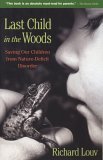
 Last Child in the Woods: Saving Our Children from Nature-Deficit Disorder
 by
Richard Louv
My rating:
3 of 5 stars
Louv has attempted an ambitious book that looks at how children can build “awareness of and appreciation for the natural world”. While he does a pretty good job of raising awareness and appreciation for this issue, and for advocating for “an environmentally based definition of mental health” there are some holes in the book’s material.
For instance, Louv never resolves the question of which benefits a child more, unsupervised play time, or more structured exposure. He quotes Rachel Carson saying, “If a child is to keep alive his inborn sense of wonder needs the companionship of at least one adult who can share it, rediscovering with him the joy, excitement, and mystery of the world we live in.” But at the same time, he spends a good part of the book lamenting the fact that kids don’t have free play time and access to open areas to build tree forts and the like. With time and resources being limited, what should parents throw their effort behind?
While the book does make the case to make more of an effort to expose children to the natural world in general it is very weak on practical suggestions. The only immediately implementable suggestion is on page 163 and can basically be summed up as, “take younger kids on short walks because they get bored easily.” Nowhere in the book does he even recommend the simple act of giving your child a pair of binoculars. An hour spent on pinterest would give a parent more practical ideas. After getting the reader all riled up, it would have been great to follow up with some concrete actions.
Also, for a pretty comprehensive book, Louv doesn’t touch on some pretty big stumbling points about why kids don’t play outside as much. He doesn’t really talk about how some other countries do a better job of protecting communal spaces when undertaking land development. He alludes to this problem by stating, “In some cases they (suburbs) offer even fewer natural spaces than the centers of old industrial cities.” While I personally observed this to be true, this goes against conventional wisdom about American suburbs and it would serve his case to delve deeper on this point.
While stating correctly that “generalized, hour to hour physical activity is the likely absent ingredient” in children’s lives today, he doesn’t address the increased number of cars on the road, increased suburban development that favors highways over sidewalks and the fact that multi-generational living arrangements are increasingly not the norm. All of these make getting that hour to hour physical activity problematic. Louv has a whole chapter addressing parent’s fears about letting their children play outdoors unsupervised, but doesn’t once address the fact that grandparents who used to “watch” the neighborhoods no longer do so, because families choose to have older generations living separately or in retirement homes. (Michelle Obama has observed this point as well). This is a huge oversight on Louv’s part.
It’s worth noting that while Louv is comfortable accusing American parents of overreacting to the fear of abduction, etc. he admits in later chapters that he didn’t let his own children outside without a cell phone.
By far my biggest beef with the book is that I don’t buy Louv’s allegation that an urban childhood automatically leads to an adult who won’t appreciate or respect nature. Despite a typical urban childhood, I am much more eco-minded than my husband who grew up in the suburbs. Plus, most American children ARE growing up in urban environments and so lamenting the fact that kids today are not going to have the exact experiences he did is not helpful to parents who have young children and are reading this book. There is nothing so frustrating as being informed about a serious problem and being left so in the wind as to how to appropriately address it.
Still, Louv is raising awareness on an important topic that has not gotten enough attention in general, and for that he should be commended.
View all my reviews
 Mere Christianity by C.S. Lewis
.jpg)