Sunday, March 23, 2014

Book Review: Mere Christianity by C. S. Lewis

Mere ChristianityMere Christianity by C.S. Lewis
My rating: 5 of 5 stars

Highly Recommended - I listened to this as an Audiobook, which I think was best because it was originally radio addresses. I thought of it as a succinct intro to comparative religion along with a layman's review of the tenants of Christianity. I had heard this book referenced in multiple places, that is why it made my reading list and I am very sorry I didn't read it (or in this case, listen to it) sooner. While not everyone will agree with all of his arguments, there is a lot of food for thought here.

View all my reviews

Thursday, March 6, 2014

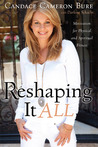
Book Review: Reshaping It All by Candace Cameron Bure

Reshaping It All: Motivation for Physical and Spiritual FitnessReshaping It All: Motivation for Physical and Spiritual Fitness by Candace Cameron Bure
My rating: 4 of 5 stars

I remember being a fan of Candace Camerson, so when she turned up years later, looking more like Pamela Anderson than D.J. Tanner, with three kids under her belt, I decided to give “Reshaping It All” a look. It really is a lovely book, approaching being kind to yourself from a spiritual aspect. However, all of her advice has separately been reinforced by various fields of research (from positive psychology work as well as others). A lot of it is familiar. I thought it was a bit odd to have quotes from the bible right next to recipes but isn’t that one of the things we love about Pinterest? Four stars for a nice read, but I’m not sure about her recipes and she doesn’t talk enough about her struggle with eating disorders and her decisions to have surgery (she’s obviously had some).

View all my reviews

Wednesday, February 26, 2014

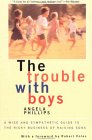
Book Review: The Trouble With Boys by Angela Phillips

The Trouble With Boys: A Wise And Sympathetic Guide To The Risky Business Of Raising SonsThe Trouble With Boys: A Wise And Sympathetic Guide To The Risky Business Of Raising Sons by Angela Phillips
My rating: 4 of 5 stars

This is a little gem of a book that I happened upon by accident. Angela Phillips takes a succinct yet pretty comprehensive look at how boys learn to become men and she is not impressed. This book is for parents- mother and fathers - who “look at what the world does to boys and they feel afraid.”

How does a sweet young boy turn into a thug? Why don’t more fathers keep in contact with their kids after divorce? In deconstructing how boys are socialized, Phillips comes to some conclusions – and some not everyone will agree with such as “There is no socially sanctioned way in which boys can show their anxiety and ask for help.” and, “they (boys) grow up in a world in which…they cannot easily ask for protection without appearing “wimpish”. Without clear guidance from father figures “the most dominant figures on the playground who will convey most forcibly what it means to be male.”

Phillips also has plenty to say about men’s roles in the family. If a father is the primary wage earner and nothing else – what happens when he gets laid off or if his wife makes more money? Her response: “Once we accept that boys, as much as girls, have a right to a place in the family by virtue of their connection with their children, not only their ability to provide money, all the questions of access to power in the world will start to chance.

One of Phillips’ main points is beautifully summed up as follows: “If men had applied themselves to fathering with the same diligence as women moved into the world of work, we would be well on the way to producing a generation of young men and women with a rich reservoir of useful early memories to draw on for images of father love.”

In general, this was an eye opening read that really asked some important questions of how boys are socialized in today’s post-feminist world. It also had the best one-paragraph summary of Freud’s work I think I’ve come across. I took away a star because there are some editing issues with the text. Phillips has worked hard addressing a complex topic thoroughly and compassionately.


View all my reviews

Monday, February 17, 2014

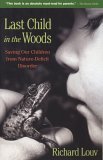
Book Review: Last Child in the Woods by Richard Louv

Last Child in the Woods: Saving Our Children from Nature-Deficit DisorderLast Child in the Woods: Saving Our Children from Nature-Deficit Disorder by Richard Louv
My rating: 3 of 5 stars

Louv has attempted an ambitious book that looks at how children can build “awareness of and appreciation for the natural world”. While he does a pretty good job of raising awareness and appreciation for this issue, and for advocating for “an environmentally based definition of mental health” there are some holes in the book’s material.

For instance, Louv never resolves the question of which benefits a child more, unsupervised play time, or more structured exposure. He quotes Rachel Carson saying, “If a child is to keep alive his inborn sense of wonder needs the companionship of at least one adult who can share it, rediscovering with him the joy, excitement, and mystery of the world we live in.” But at the same time, he spends a good part of the book lamenting the fact that kids don’t have free play time and access to open areas to build tree forts and the like. With time and resources being limited, what should parents throw their effort behind?

While the book does make the case to make more of an effort to expose children to the natural world in general it is very weak on practical suggestions. The only immediately implementable suggestion is on page 163 and can basically be summed up as, “take younger kids on short walks because they get bored easily.” Nowhere in the book does he even recommend the simple act of giving your child a pair of binoculars. An hour spent on pinterest would give a parent more practical ideas. After getting the reader all riled up, it would have been great to follow up with some concrete actions.

Also, for a pretty comprehensive book, Louv doesn’t touch on some pretty big stumbling points about why kids don’t play outside as much. He doesn’t really talk about how some other countries do a better job of protecting communal spaces when undertaking land development. He alludes to this problem by stating, “In some cases they (suburbs) offer even fewer natural spaces than the centers of old industrial cities.” While I personally observed this to be true, this goes against conventional wisdom about American suburbs and it would serve his case to delve deeper on this point.

While stating correctly that “generalized, hour to hour physical activity is the likely absent ingredient” in children’s lives today, he doesn’t address the increased number of cars on the road, increased suburban development that favors highways over sidewalks and the fact that multi-generational living arrangements are increasingly not the norm. All of these make getting that hour to hour physical activity problematic. Louv has a whole chapter addressing parent’s fears about letting their children play outdoors unsupervised, but doesn’t once address the fact that grandparents who used to “watch” the neighborhoods no longer do so, because families choose to have older generations living separately or in retirement homes. (Michelle Obama has observed this point as well). This is a huge oversight on Louv’s part.

It’s worth noting that while Louv is comfortable accusing American parents of overreacting to the fear of abduction, etc. he admits in later chapters that he didn’t let his own children outside without a cell phone.

By far my biggest beef with the book is that I don’t buy Louv’s allegation that an urban childhood automatically leads to an adult who won’t appreciate or respect nature. Despite a typical urban childhood, I am much more eco-minded than my husband who grew up in the suburbs. Plus, most American children ARE growing up in urban environments and so lamenting the fact that kids today are not going to have the exact experiences he did is not helpful to parents who have young children and are reading this book. There is nothing so frustrating as being informed about a serious problem and being left so in the wind as to how to appropriately address it.

Still, Louv is raising awareness on an important topic that has not gotten enough attention in general, and for that he should be commended.


View all my reviews

Sunday, February 9, 2014

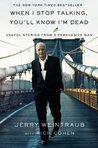
Book Review: When Stop Talking, You'll Know I'm Dead by Jerry Weintraub and Richard Cohen

When I Stop Talking, You'll Know I'm Dead: Useful Stories from a Persuasive ManWhen I Stop Talking, You'll Know I'm Dead: Useful Stories from a Persuasive Man by Jerry Weintraub
My rating: 5 of 5 stars

An awesome fun read! Ever have a great fun night at a bar while people tell great stories? Reading this book was like having that experience. The energy and passion that comes through is infectious- Weintraub and Cohen make a great story-telling team. Weintraub’s life exemplifies the “you don’t ask, you don’t get” philosophy. This book earns five stars because I shed a few real tears during the chapter about his parent’s passing. That said I didn’t believe for one minute he was telling you the whole truth about his life- especially about his drug use and marriages. However, it didn’t get in my way of enjoying the book and learning a few things.

View all my reviews

Thursday, February 6, 2014

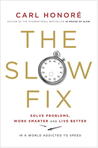
Book Review: The Slow Fix by Carl Honoré

The Slow Fix: Solve Problems, Work Smarter and Live Better in a World Addicted to SpeedThe Slow Fix: Solve Problems, Work Smarter and Live Better in a World Addicted to Speed by Carl Honoré
My rating: 4 of 5 stars

To be fair to the author Carl Honoré, this must have been a difficult book to write.

In today’s fast paced world, the author attempts to put forth a series of case studies in the benefits of taking the time to slow down. The resulting list, with admonishments to “think holistic” and “think long” and “collaborate”, fall somewhere between general good advice and overused platitudes.

Still the book has its moments. Honoré reminds us that penicillin was discovered because a doctor took his month long August vacation (I’m going to trust he did his research on that one and that is what actually happened). He also defends time spent gaming, putting forth the theory that it helps build valuable problem solving skills (a brave argument considering the books target audience). The case studies on the prison systems in Norway and organ donation in Spain were interesting.

Ironically enough for a book advocating slowness, he doesn’t dig deep enough on some of his examples. For example during a paragraph about how Steve Jobs spent time paying attention to details I found myself talking back to the book saying, “Yeah but Honoré, Jobs also said “Real Artists Ship”.

Despite all the problem solving vignettes (and there are plenty, often they are non-sequiturs), Honoré doesn’t tackle the two questions I thought his book would address. The first is, “Where is the fine line between a ‘slow fix’ and procrastination?” The second is, “How can you tell you are taking the right amount of time to solve a problem?”

I don’t know that the author really delivered on the book jacket description to deliver “a new paradigm for efficient, sustainable problem solving” but in general it’s always a good reminder to slow down and think.


View all my reviews